
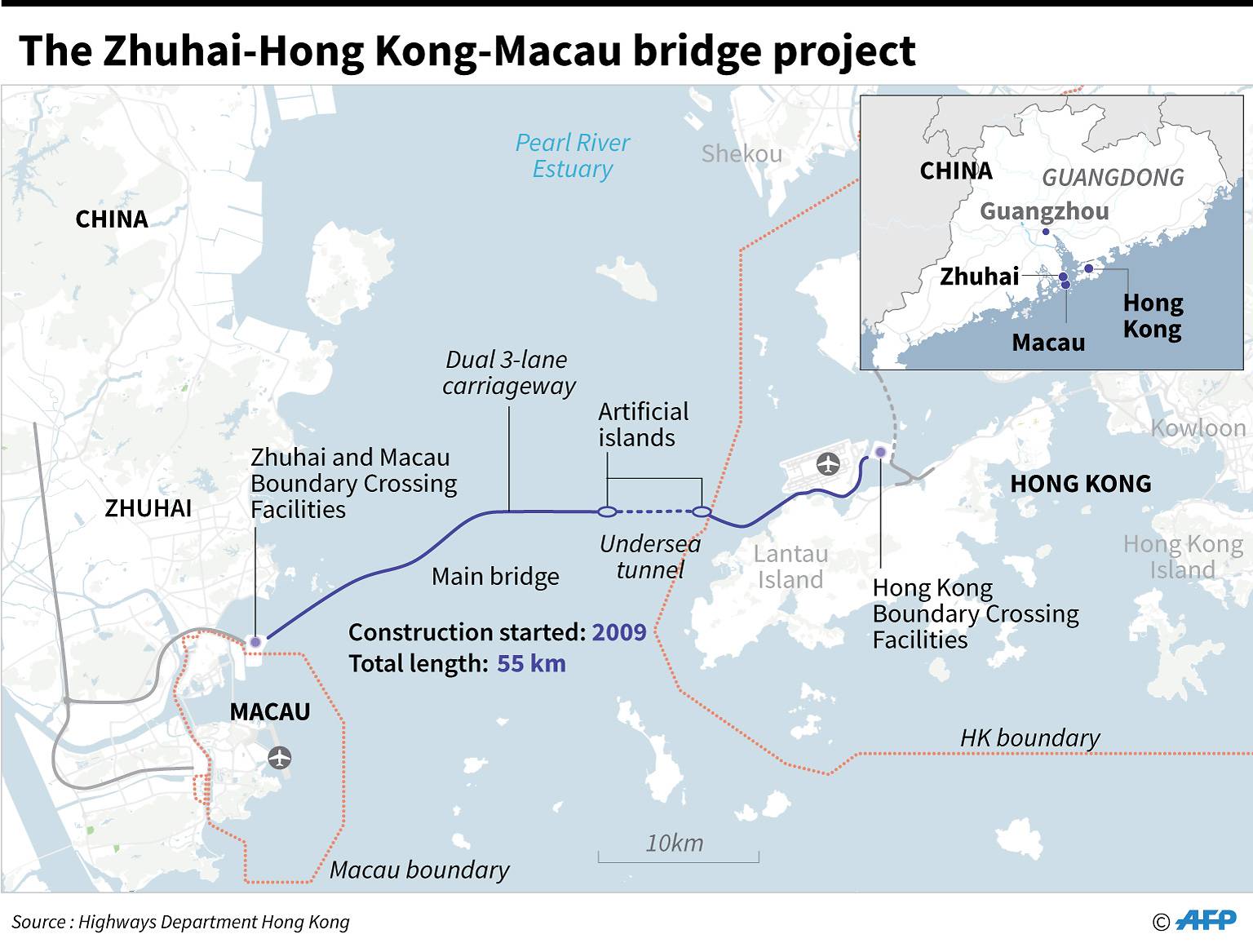
ZHUHAI: The world's longest sea-bridge connecting Hong Kong, Macau and mainland China will be launched on Tuesday (Oct 23) at a time when Beijing seeks to tighten its grip on its semi-autonomous territories.
President Xi Jinping is expected to officiate at an opening ceremony in the mainland city of Zhuhai Tuesday morning, but details of the cloak-and-dagger event have been kept secret.
The 55-kilometre crossing, which includes a snaking road bridge and underwater tunnel, links Hong Kong's Lantau island to Zhuhai and the gambling enclave of Macau, across the waters of the Pearl River Estuary.
It is the second major infrastructure project tying Hong Kong to mainland China to launch in a matter of weeks after the opening of a high-speed rail link last month.
Building began in 2009 and has been dogged by delays, budget overruns, corruption prosecutions and the deaths of construction workers.
The launch ceremony was hastily announced last week by mainland authorities with Hong Kong lawmakers and transport companies complaining they had been left in the dark.
Supporters of the project promote it as an engineering marvel that will also boost business and cut travel time, while others see it as a politically driven costly white elephant.
The main bridge section is considered mainland territory and Hong Kong cars and drivers travelling over it "must comply with the laws and regulations of the mainland", according to the city's transport department.
Hong Kong residents will only be granted a licence to cross into Zhuhai if they meet highly selective criteria, including holding certain mainland government positions or making major contributions to charities in the southern Chinese province of Guangdong.
Most people will need to travel the bridge on coaches and buses.
Online commenters in Hong Kong complained about the bridge's restricted access ahead of the launch.
"Such a huge investment using the Hong Kong taxpayer's money ... yet basically it is not open to us at all," said one comment on the South China Morning Post website.
Some Hong Kong media reported that the physical condition of drivers would be monitored by cameras, including an alert sent if a driver yawns more than three times in 20 seconds.
Data such as a driver's heart rate and blood pressure would also be collected through wearable devices and sent to the control centre.
The opening of the high-speed rail link also sparked criticism as it saw Chinese security stationed on Hong Kong soil for the first time at the city's terminus.
Critics accused the Hong Kong government of giving away territory to an increasingly assertive Beijing.
 Afghanistan
 Armenia
 Azerbaijan
 Bahrain
 Bangladesh
 Bhutan
 Brunei
 Cambodia
 China
China Cyprus
 East Timor
 Georgia
 Hong Kong
 India
India Indonesia
 Iran
Iran Iraq
Iraq Israel
 Japan
Japan Jordan
 Kazakhstan
 Kuwait
 Kyrgyzstan
 Laos
Laos Lebanon
 Macau
Macau Malaysia
 Maldives
 Mongolia
 Myanmar
 Nepal
Nepal North Korea
 Oman
Oman Pakistan
 Palestine
 Philippines
 Qatar
Qatar Russia
 Saudi Arabia
 Singapore
 South Korea
 Sri Lanka
 Syria
Syria Taiwan
 Tajikistan
 Thailand
 Turkey
 Turkmenistan
 U.A.E
U.A.E Uzbekistan
 Vietnam
 Yemen
Yemen 

© 2021 ASIA-PAGES Enterprise Co., Ltd.
TEL : (+886) 03-323-9284